Stranded in a car in winter? Rehearse the first hour.
The vehicle is shelter, a landmark and a communications base—but it can also become dangerously cold or fill with carbon monoxide. Practice the decisions while parked safely at home: report the location, make the vehicle visible, insulate people, ration power and verify the exhaust plan.
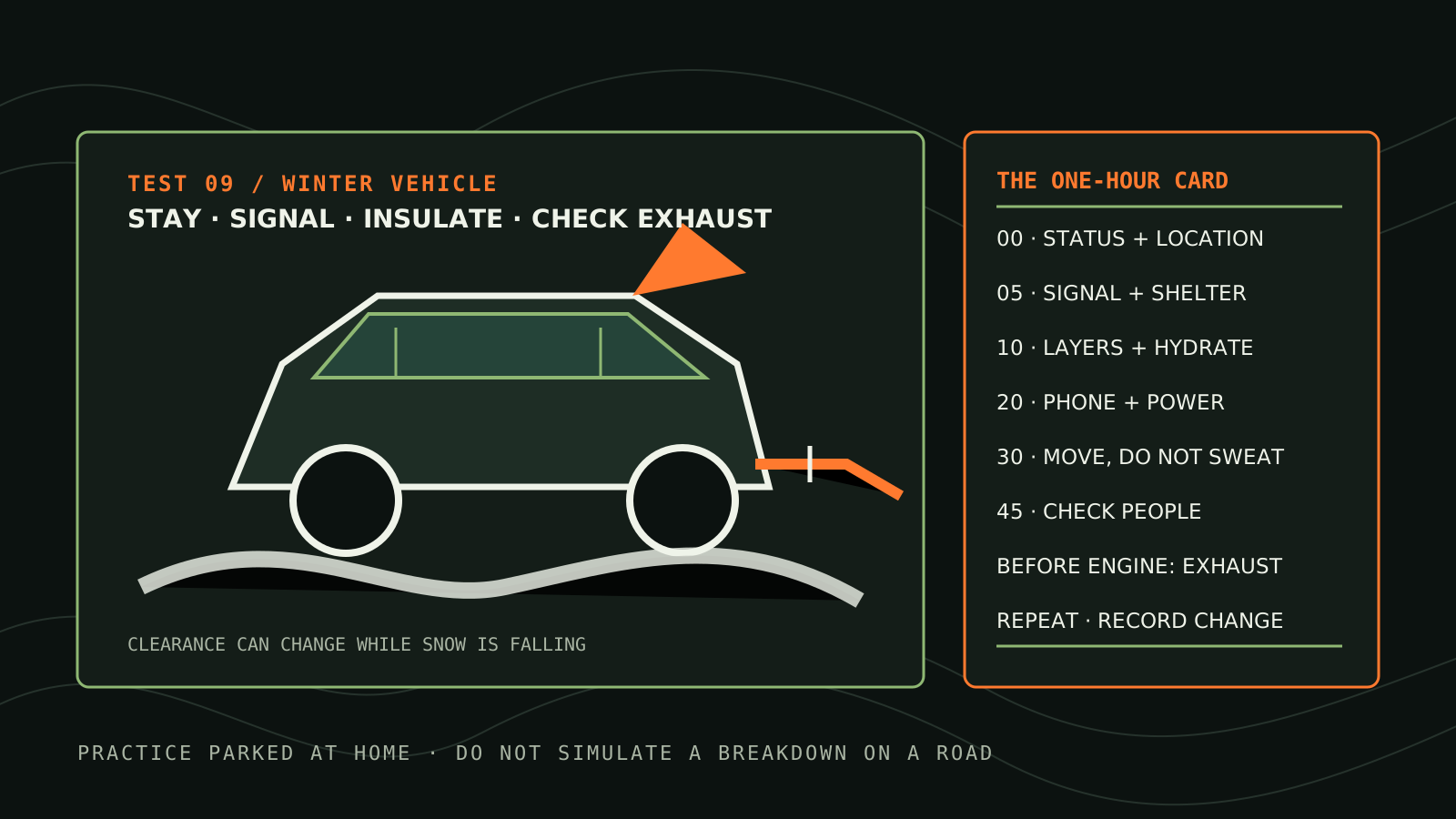
The first decision is whether to travel
The best stranded-vehicle plan begins before the wheels move. NHTSA advises checking weather and traffic reports, postponing nonessential travel when roads are poor, reviewing directions, sharing the route and expected arrival time, and keeping fuel or vehicle charge available. CDC similarly advises avoiding travel in low visibility and on ice-covered roads where possible.
Write a trip message that another person can act on: vehicle description and plate, occupants, route, destination, departure, expected arrival, planned stops and the time they should contact authorities if you do not check in. An app location share is useful, but a written route still works when the phone, account or network does not.
Current public discussions often fixate on one piece of gear—an emergency blanket, candle, traction board or all-wheel drive. The official guidance points to a system instead: avoid the hazard, maintain the vehicle, keep a route contact, stay with the shelter, prevent carbon monoxide exposure, preserve warmth and remain visible.
If you stop, separate three different problems
| Condition | Immediate priority | Do not assume |
|---|---|---|
| Stalled or stuck, no collision or medical emergency | Report location, stay with the vehicle, signal, conserve warmth and power. | That pushing or walking is safer than waiting. |
| Collision, injury, fire, unstable roadside or traffic exposure | Call 911, follow dispatch and address immediate life threats. | That generic stay-put advice overrides the scene hazard. |
| Snow building around the vehicle | Track exhaust clearance and ventilation before any engine use. | That a previously clear tailpipe remains clear. |
| Cold cabin with vulnerable passengers | Add dry insulation, monitor condition and escalate early. | That the vehicle heater or one blanket will be enough. |
When it is safe to remain, NWS, CDC and NHTSA generally advise staying with the vehicle. It is easier to find than a person in blowing snow and provides protection from wind and precipitation. Follow emergency responders; leave only when staying creates an immediate threat or a clearly safer shelter is very close.
Minute 0: call and send a usable location
Call 911 for a life-threatening emergency or when directed by local authorities. If the situation is not an immediate emergency, use the road-assistance or transportation contact appropriate to the location. Give the road name and direction of travel, nearest mile marker or exit, coordinates and their format when available, nearby signs or landmarks, vehicle description, occupant count, injuries, fuel or charge, weather and whether traffic can see you.
Send the same information to the trip contact. A location pin alone can be stale or ambiguous, so pair it with words and a screenshot. Keep the phone warm near the body, reduce screen use, close unnecessary apps and move it to low-power mode. Do not leave it plugged into a dead vehicle in accessory mode until the starter battery is exhausted.
The 30-second location report
- Where: road, direction, mile marker or exit, coordinates and visible landmark.
- What: stuck, stalled or crashed; state fire, injury or traffic hazards first.
- Who: number of adults, children, older people, medical or accessibility needs and pets.
- Vehicle: color, model, plate and where it sits relative to the traveled lane.
- Resources: fuel or charge, heat, clothing, food, water, phone power and expected wait.
Minute 5: make the vehicle findable
Turn on hazard lights when appropriate and safe. NHTSA and NWS recommend bright markers on the antenna, mirror, door or windows and the interior dome light when the engine is running at night. After snowfall stops, official guidance may recommend raising the hood to indicate trouble. Follow responder instructions and do not step into moving traffic to place a marker.
Move needed kit items from the trunk to the passenger area before drifting snow, traffic or a frozen latch makes access harder—but only when it is safe to exit. Keep doors closed afterward. If there is a crash risk, move occupants as dispatch directs and use seat belts when seated.
Minute 10: build warmth without creating another hazard
Put on dry layers before you are deeply chilled. Cover the head, neck, hands and feet; wrap the entire body in coats, blankets or sleeping bags. Place dry insulation beneath occupants as well as over them because seats and floors draw heat. Huddle when appropriate and keep infants, older adults, people with limited mobility and anyone with health conditions under closer observation.
Use gentle arm, leg, finger and toe movement to support circulation, but avoid sweating and overexertion. NWS and CDC caution against heavy shoveling, pushing the vehicle or walking through deep snow. Wet clothing and exhaustion reduce the margin you are trying to preserve.
Eat and drink regularly if supplies allow. CDC says not to eat snow because it lowers body temperature. Do not use alcohol. Never burn a candle, stove, grill or other combustion device inside the passenger compartment; it adds fire and carbon monoxide risk.
The engine rule starts with carbon monoxide
Carbon monoxide is colorless and odorless. CDC warns that snow blocking a tailpipe can make CO build quickly inside a vehicle. The absence of an exhaust smell does not prove the air is safe. A collision or damaged exhaust system may add risk even when the tailpipe looks open.
NWS and CDC guidance says to run the engine and heater for about 10 minutes each hour, open a window slightly for fresh air and make sure snow is not blocking the exhaust pipe. NHTSA says to run the vehicle only sporadically, just long enough to stay warm. Treat that as a conditional upper routine, not permission to idle whenever clearance is unknown.
- Before every engine run, assess whether it is safe to step out and inspect. Traffic, visibility, unstable snow, avalanche conditions, injury or severe wind can make exiting more dangerous.
- Confirm that the exhaust outlet and the area around it are clear. Snow can drift back between checks.
- Open a window slightly as official guidance directs and keep occupants awake and observant.
- Run only for the limited warming period recommended by responders or current official guidance.
- Turn the engine off and record the time. Recheck conditions before the next run.
Build a kit around passengers and route
NHTSA’s winter list includes a shovel, broom and ice scraper; sand or another abrasive traction material; jumper cables; flashlight; warning devices; first aid and necessary medicines; blankets; bottled water; nonperishable food; a phone and car charger. That is a baseline, not a universal packed quantity.
| Module | Pack and verify | Field test |
|---|---|---|
| Warmth | Dry hats, mittens, socks, insulating layers, blankets or sleeping bags sized for every occupant. | Everyone can put layers on while belted or in a cramped cabin. |
| Visibility | Bright cloth or marker, flashlight, reflective warning devices used according to local rules. | Reach them without entering traffic. |
| Snow and traction | Shovel, scraper, brush, vehicle-compatible traction aid and exact tire-chain instructions if carried. | Fit and handling practiced before snow; never under a moving vehicle. |
| Power | Charged phone bank, correct cables, flashlight batteries and vehicle jump method. | Phone receives a charge in the cold; jump procedure matches the manual. |
| Health | First aid, medicines, mobility and communication aids, child and pet needs. | Critical items stay with the person, not locked outside the cabin. |
| Food and water | Ready-to-eat food, water and containers selected for expected freezing conditions. | Food opens without extra tools and water storage is inspected for leaks. |
Do not store gear loose where it can become a projectile in a crash. Secure the kit, keep urgent items reachable and review vehicle load limits. Rotate medicines, food, water and batteries. A summer bottle frozen solid and a power bank left empty are inventory, not capability.
Run the parked-at-home first-hour drill
Choose a cold but safe day at home. Park outdoors in a legal, level place away from traffic. Keep the engine off for the exercise. Tell participants it is a drill, keep emergency calling disabled and use a written scenario instead of creating a real hazard.
- Start seated as the normal trip party. One person reads: “Road closed, vehicle cannot move, help may take two hours.”
- Build the 30-second location report from an offline map and the phone’s location screen.
- Reach the bright marker, light, clothing, blanket, water, food and medical items without emptying the entire trunk into snow.
- Put on layers and insulate below and above each person. Note items that do not fit over ordinary clothing or car seats.
- Point to the tailpipe, show how clearance would be assessed, state the no-run conditions and simulate the hourly engine timer without starting.
- Send a non-emergency test message to the designated contact, then put the phone into low-power mode and connect the backup battery.
- Use the printed hour card. Record every delay, missing item, ambiguous instruction and passenger need.
End before anyone becomes cold, tired or distressed. The drill tests access and decisions, not cold tolerance. Repeat after the vehicle, route, season, passenger list, medical needs or phone changes.
Print the one-hour safety card
Stranded vehicle · one-hour cycle
Location / road / direction
Coordinates / landmark
People / urgent needs
00 Report status and location. Follow dispatch.
05 Signal safely. Move kit inside. Close doors.
10 Add dry layers above and below. Hydrate.
20 Check phone contact, battery and power plan.
30 Move gently. Avoid sweat and overexertion.
45 Check every person for worsening condition.
Before any engine run Safe to inspect? Tailpipe and area clear? Window slightly open? Exhaust undamaged? Official guidance allows it? If any answer is uncertain, do not run.
Last engine check / run
Next contact / condition change
Questions readers ask
Should I stay in the vehicle?
Usually, when the vehicle is in a safe place and winter conditions make walking dangerous. It provides shelter and is easier to find. A fire, unstable roadside, collision hazard, avalanche or flood threat can change the decision; call 911 and follow responders.
Should I keep the engine running?
No. NWS and CDC describe limited use—about 10 minutes per hour—with a window slightly open and only when the tailpipe is clear. Recheck because drifting snow changes conditions. Do not run the engine if clearance, ventilation or exhaust integrity is uncertain.
Is all-wheel drive enough preparation?
No. It can help a vehicle accelerate but does not eliminate stopping distance, visibility, tire, battery, fuel, route or weather limits. The plan still needs a route contact, vehicle maintenance, warm layers, communication and a decision to postpone unsafe travel.
Sources checked
- National Weather Service — What to Do If You’re Caught in a Winter Storm
- National Highway Traffic Safety Administration — Winter Driving Tips
- CDC — Stay Safe During and After a Winter Storm
- CDC — Clear Snow from Tailpipes
- CDC — Carbon Monoxide Poisoning Basics
Reviewed November 4, 2026. Weather, road restrictions, vehicle instructions and local emergency procedures change. Follow responders, current official alerts and the exact vehicle manual.